Program
Logistics Engineering Program
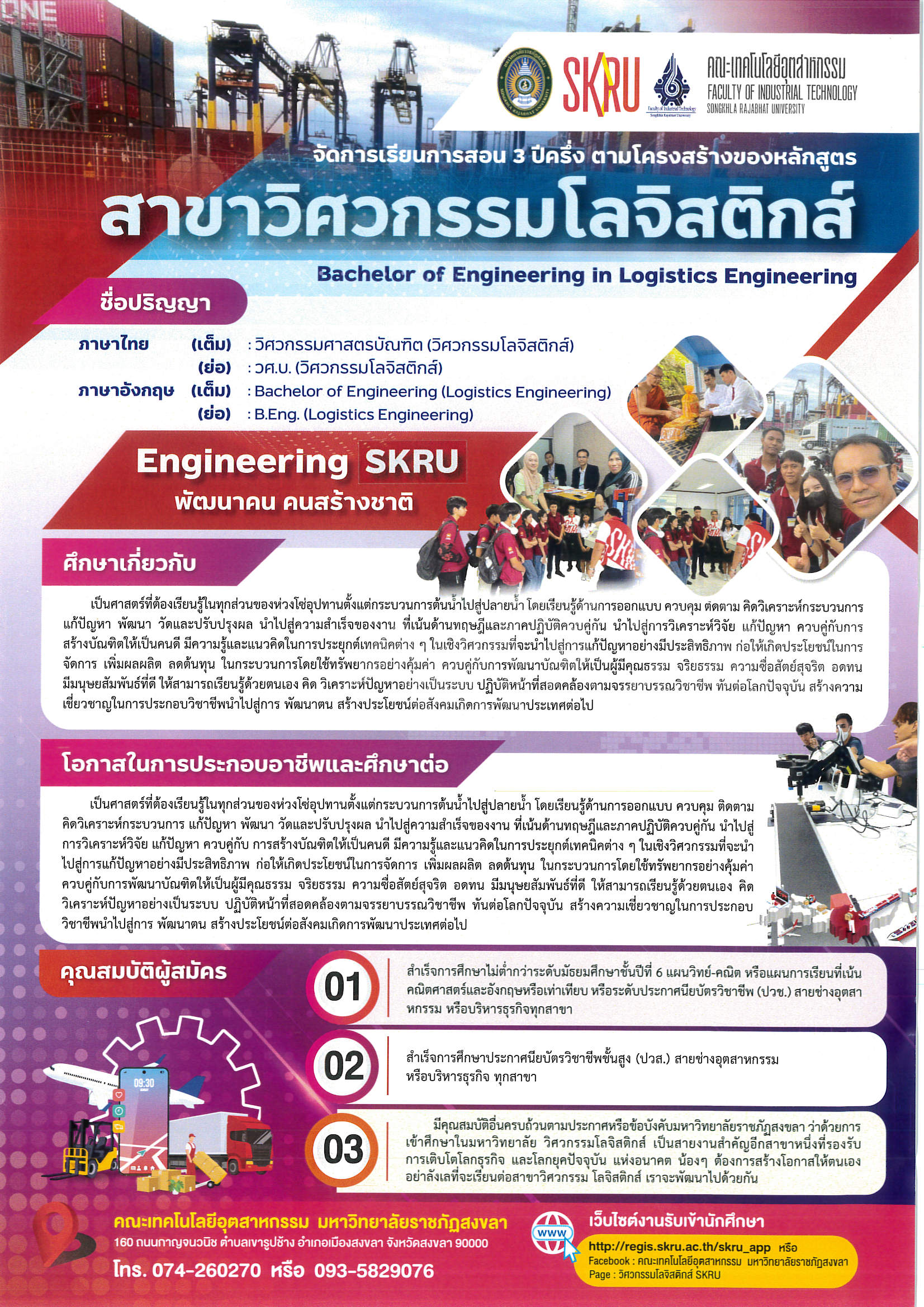
3.5-year program based on the curriculum structure
Degree
Bachelor of Engineering (Logistics Engineering)
B.Eng. (Logistics Engineering)
Bachelor of Engineering (Logistics Engineering)
B.Eng. (Logistics Engineering)
About the program
Logistics Engineering studies the entire supply chain from upstream to downstream. Students learn to design, control, monitor and analyze processes, solve problems, develop, measure and improve outcomes. The program balances theory and practice, leading to research and problem-solving skills while developing graduates with integrity and the ability to apply engineering techniques to improve productivity and reduce costs.
Admission requirements
Completed high school (Science-Math track) or equivalent, or Vocational Certificate (VET) in industrial trades or business fields.
Completed Higher Vocational Certificate (Diploma/Vocational Diploma) in industrial trades or business fields.
Meet other requirements as specified by the university regulations.
Program Learning Outcomes (POL)
Program Learning Outcomes (PLOs) for the Bachelor of Engineering in Logistics Engineering (Revised Curriculum 2021) are grouped into five domains:
1) Ethics and Professional Conduct
- Integrity & sufficiency mindset: uphold honesty, selflessness, and a sufficiency-based way of living.
- Responsibility: be disciplined, punctual, accountable, and respect organizational rules.
- Professional ethics: follow academic/engineering ethics and understand social contexts of the profession.
- Respect for others: respect rights, listen to opinions, and honor human dignity.
2) Knowledge
- Fundamentals: apply mathematics, science, and engineering fundamentals to practice and innovation.
- Specialized knowledge: master key principles and theories in logistics and supply chain engineering.
- Lifelong learning: keep up with academic developments and related research areas.
- Tools application: analyze and solve problems using appropriate tools (e.g., computer software).
3) Cognitive Skills
- Critical thinking: gather, analyze, and synthesize issues and needs systematically.
- Problem solving: solve engineering problems using evidence-based decisions.
- Creativity: flexibly apply knowledge to innovate or improve existing work.
- Self-directed learning: search and learn new knowledge to keep up with emerging technologies.
4) Interpersonal Skills and Responsibility
- Communication & teamwork: communicate effectively (Thai/English) and work as a leader or team member.
- Creative leadership: initiate constructive solutions and support others.
- Social responsibility: prioritize workplace safety and environmental stewardship.
5) Numerical Analysis, Communication, and IT Skills
- Digital skills: use modern IT tools effectively for work and communication.
- Data analysis: apply mathematical/statistical analysis for creative problem solving.
- Engineering communication: communicate in Thai and English in speaking and writing.
- Engineering tools: use calculation and engineering tools to support professional practice.
Booklet
ไฟล์เล่มหลักสูตรรวมรายละเอียดรายวิชา โครงสร้างหลักสูตร และข้อกำหนดการสำเร็จการศึกษา
Download Program BookletProgram Poster - Logistics Engineering