Program
Industrial Electrical Technology Program
What You Will Study
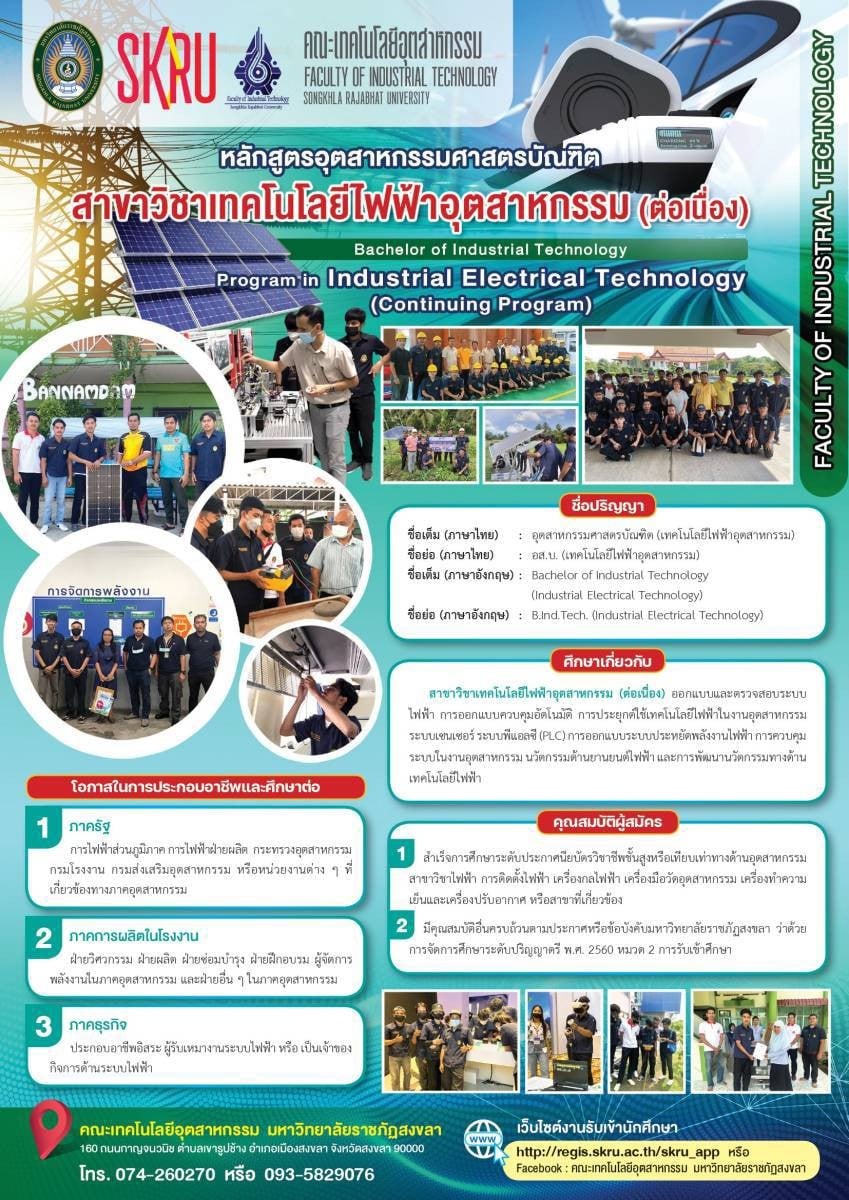
The Industrial Electrical Technology Program (Continuing Program) focuses on producing graduates with the knowledge and ability to apply knowledge and technology in the professional field of industrial electrical technology, such as designing electrical systems according to electrical installation standards, checking, measuring, and maintaining electrical equipment and systems, applying automation systems such as PLC, planning energy conservation, using renewable energy, and developing innovations in electrical technology, taking safety and accuracy into account, communicating and presenting using information technology media appropriately, working as a team, self-directed learning, and possessing moral and ethical principles to meet local and societal needs.
Admission Requirements
High Vocational Certificate (Diploma/Vocational Diploma) or equivalent in industrial fields: Electrical, Electrical Power, Electrical Installation, Electrical Machines, Industrial Instrumentation, Electrical System Maintenance, Control Electrical, Refrigeration and Air Conditioning, Electronics or related fields, with a GPA of not less than 2.50.
Career Opportunities
Industrial Production Sector
Electrical department supervisor/electrical engineering technician, maintenance department, engineering department, production department, and other departments in large industrial or agricultural sectors.
Government Sector
Provincial Electricity Authority (PEA) employees, Electricity Generating Authority of Thailand (EGAT) employees, engineering and maintenance officers in government agencies, industrial-related organizations, and technical/engineering departments in various government agencies.
Business & Service Sectors
Electrical system operators in business and service establishments, electrical system contractors, and owners of electrical system businesses.
Program Learning Outcomes (PLOs)
PLOs
Industrial Electrical TechnologyDemonstrate moral, ethical responsibility, and professional ethics, taking into account safety and accuracy in electrical works.
Work as a team, practice self-directed learning, and communicate/present using information technology media appropriately.
Design electrical systems according to specified electrical installation standards.
Inspect, measure, and maintain electrical equipment and systems.
Apply automation systems.
Plan energy conservation and utilize renewable energy.
Inspect and maintain electrical systems in electric vehicles.
Develop innovations in electrical technology.
Booklet
Download Program BookletThe program booklet contains course details, curriculum structure, and graduation requirements.
Program Poster - Industrial Electrical Technology